
/https://tf-cmsv2-journeys-media.s3.amazonaws.com/filer_public/22/5f/225f5494-fea9-43d4-bff5-c091f1b570d2/ny_niagarafalls_americanside_aerial_autumn_dt_xl_82312100.jpg)
A Voyage Along the Great Lakes
9 days from $9,750
Aboard a 184-guest small ship
Voyage by Smithsonian Journeys and PONANT EXPLORATIONS
Straddling the shores of the United States and Canada, the Great Lakes are a freshwater treasure trove of wild islands, unusual geology, and legendary waterfalls. Their intriguing heritage is woven from American Indian culture, French colonists and the fur trade, and maritime traditions. Make your way through four of the five Great Lakes, discovering a wealth of natural wonders and historic sites from Michigan’s Upper Peninsula to Niagara Falls.
Highlights
The Smithsonian Journeys / PONANT Experience: Each cruise will be accompanied by two Smithsonian Journeys Experts. An excursion or activity is included in each port of call. You may have a choice of excursions in many ports, so that you can delve more deeply into subjects that interest you.
- Welland Canal: Find a spot on deck to watch as the ship is raised 326 feet through the eight locks of the Welland Canal, which connects Lake Ontario and Lake Erie.
- Niagara Falls: Ride a boat right up to the spray of Niagara Falls, getting thrillingly close to Horseshoe Falls, then enjoy a leisurely cruise on Lake Erie.
- Manitoulin Island: On the world's largest freshwater island, learn about the local First Nations traditions at the Ojibwe Cultural Foundation, hike the Cup and Saucer Trail for sweeping views, or kayak through wetlands on Kagawong River.
- Sault Ste. Marie: See the spectacular falls at Tahquamenon Falls State Park and trace maritime history at the Great Lakes Shipwreck Museum. Or experience the engineering marvel of the Soo Locks at the Sault Lock Viewing Station and Interpretive Center, explore an authentic freighter at the Valley Camp Museum Ship, and navigate the locks on a local cruise.
- Mackinac Island: Tour this timeless island in a horse-drawn carriage, viewing the iconic Grand Hotel and visiting Fort Mackinac, a 19th-century army outpost.
Please note: The August 19, 2026, August 21, 2027, and August 26, 2028, departures will operate in the reverse direction, from Milwaukee to Toronto. Please find the full itineraries below.
/https://tf-cmsv2-journeys-media.s3.amazonaws.com/filer_public/32/8b/328b9e1e-cf49-41d7-89fa-39b52401f8bd/mi_mackinacharbor_dt_21572751.jpeg)
Itinerary
To see itinerary, please click on an option below.
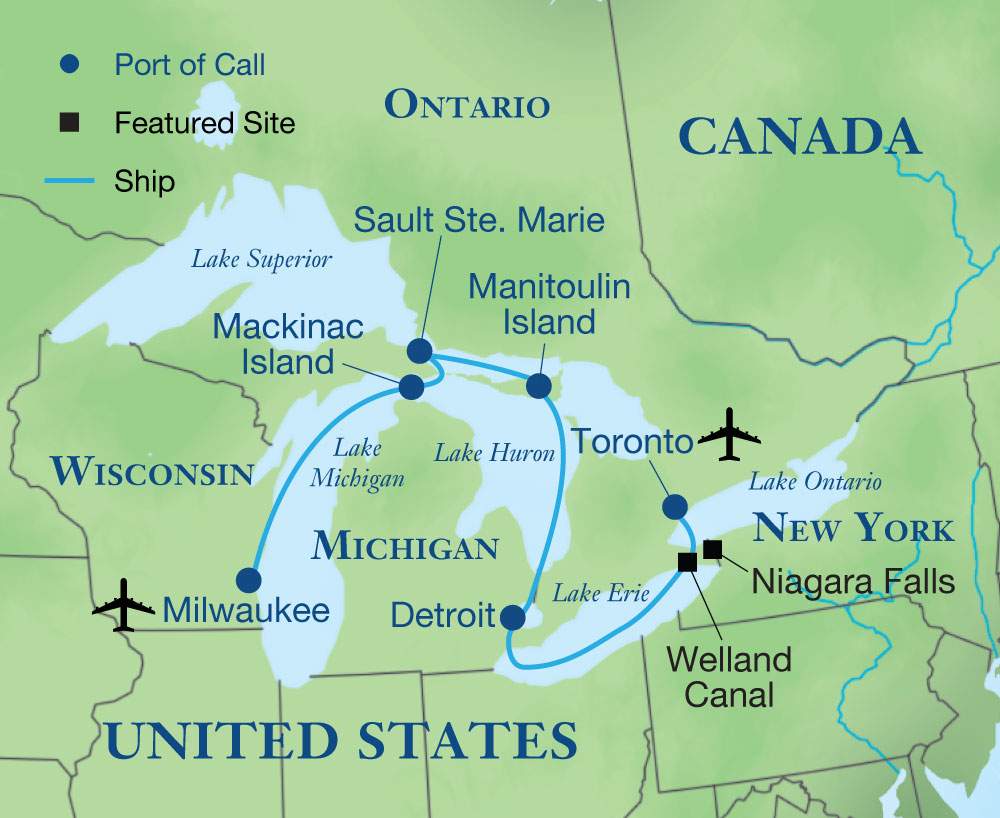
Aug 11–19, 2026: Toronto to Milwaukee
Day 1 — Toronto, Ontario, Canada
Arrive in cosmopolitan Toronto, Canada’s largest city, and settle into your cabin this afternoon. Set sail on Lake Ontario in the early evening. (D)
Day 2 — Welland Canal
Enter the Welland Canal, known for its 1,377-foot lock, one of the world's longest. Originally built in 1829 and later expanded, the canal opened a shipping route between Lake Ontario and Lake Erie. Enjoy a leisurely day on board, watching as the ship is raised 326 feet on its way through the eight locks. Arrive in the small port town of Port Colborne early this evening. (B,L,D)
Day 3 — Port Colborne and Niagara Falls, New York
From Port Colborne, set out for one of the most famous sites in North America: Niagara Falls, a group of three waterfalls that straddle the border between Ontario and New York. Pass through Chippawa, site of an important battle in the War of 1812, on the drive to the falls. Then board a specially designed vessel for an exhilarating ride to within feet of Horseshoe Falls, the largest and most powerful of the three falls. Spend the late afternoon cruising across Lake Erie. Relax with a book in the library or find a spot on deck to admire the scenery. (B,L,D)
Day 4 — Sailing through Detroit and the St. Clair River
Sail right through Detroit on the Detroit River, an important commercial waterway that follows the U.S. and Canadian border, linking Lake Erie and Lake St. Clair to Lake Huron. Enjoy panoramic views of the skyscrapers of Motor City, where Henry Ford revolutionized the automobile industry and Motown was born. Admire the Ambassador Bridge, which spans the river—and two countries. This steel suspension bridge, more than a mile long, was constructed in 1929 and today carries more than 25% of trade between the United States and Canada. Cruise the St. Clair River, which was used by French fur traders to facilitate trade with American Indian tribes in the 18th century. More recently, it has served as an integral part of the Great Lakes Waterway, a conduit for freighters transporting lumber, iron ore, and copper from the Great Lakes region to the cities of the Rust Belt. (B,L,D)
Day 5 — Lake Huron: Parry Sound and Georgian Bay
One of the largest freshwater lakes in the world, Lake Huron separates Michigan from Ontario. Its bays and channels offer a variety of coastal landscapes, from lush woodlands and rocky crags to spectacular cliffs. Dock in Parry Sound and set out on the excursion of your choice. Cruise the specially designed Island Queen on Georgian Bay, home to The Thirty Thousand Islands—the largest freshwater archipelago in the world. Navigate this maze of bays, inlets, sounds, and shoals that lie along the southern edge of the Precambrian Canadian Shield. The captain will maneuver close to the islands, allowing for views of forests, wetlands, and rocks, as well as their abundant flora and fauna. Alternatively, visit Killbear Provincial Park, a UNESCO Biosphere Reserve on the eastern shores of Georgian Bay. On a nature walk here, learn about the unusual geology of the park and learn to read the signs of glacial scouring. Discover beaches, rugged shoreline, windswept pines, and views of The Thirty Thousand Islands. Learn more about the area’s ecology at the visitor center. (B,L,D)
Day 6 — Little Current and Manitoulin Island
Little Current is the gateway to Manitoulin Island, the largest freshwater island in the world. Get acquainted with the indigenous Ojibwe people, part of the M’Chigeeng First Nation. Visit the excellent exhibition and art gallery at the Ojibwe Cultural Foundation and see traditional crafts like bead working and making dreamcatchers. Take part in a smudging ceremony (a cleansing and healing ritual) and watch a demonstration of a traditional powwow, a Native American social event featuring dances, music, and other activities. Then enjoy free time in Little Current to stroll the waterfront. Or hike the Cup and Saucer Trail to the highest point on the island—about 1,160 feet—and take in incredible views across forests and lakes. Then sample a selection of Canadian wines, beers, and cheeses, along with locally smoked rainbow trout and whitefish. Alternatively, head to the village of Kagawong for a kayaking expedition on the upper Kagawong River. Paddle calm waters through wetlands and keep your eye out for wildlife. Then walk the riverside trail to the viewing platform for Bridal Veil Falls. Stop at a family-owned chocolate business for a cup of hot cocoa or coffee and a chocolate tasting. (B,L,D)
Day 7 — Sault Ste. Marie, Michigan
Located on the northern coast of Michigan’s Upper Peninsula, Sault Ste. Marie is one of the oldest cities in the United States. After passing through passport control, embark on one of two excursions. Take a scenic drive to Tahquamenon Falls State Park for a visit to the stunning Upper and Lower Falls and enjoy a leisurely forest walk. Continue to the Great Lakes Shipwreck Museum to learn about the maritime history of the area. Visit the lightkeeper's quarters Whitefish Point Light Station, and if you wish, climb the lighthouse tower, in continuous operation for 155 years.
Or drive to the Sault Lock Viewing Station and Interpretive Center to experience the engineering marvel of the Soo Locks. Visit the Valley Camp Museum Ship, a freighter that served on the Great Lakes for almost 50 years. Its massive cargo holds now contain 20,000 square feet of exhibits, displaying artifacts, paintings, and other items related to the maritime history of Lake Superior. Then board a chartered SOO Locks boat for a cruise to the Soo Locks, where your boat is raised 21 feet to enable it to enter Lake Superior. Return to the harbor via the historic Canadian Lock, and sail past St. Mary’s rapids to Sault Ste. Marie. (B,L,D)
Day 8 — Mackinac Island and Lake Michigan
Step back in time on tiny Mackinac Island, a former fur trading center located between Michigan’s Upper and Lower Peninsula. Originally inhabited by American Indians, then occupied by French and British colonists, this island still retains an atmosphere of yesteryear, with Victorian-style buildings and elegant horse-drawn carriages. Climb aboard a horse-drawn carriage for a guided tour of the island. View the iconic Grand Hotel, which has hosted five U.S. presidents, Thomas Edison, and Mark Twain. Enjoy breathtaking views of Lake Huron from Arch Rock. Then venture into the living museum of Fort Mackinac, the site of an important battle during the War of 1812. See exhibits and re-enactments that illustrate what life was like for the families who lived in this army outpost. This afternoon, sail Lake Michigan past cliffs, beaches, and dunes as far as the eye can see. (B,L,D)
Day 9 — Milwaukee, Wisconsin/Return Home
Disembark in Milwaukee, nestled on the shores of Lake Michigan, and transfer to airport for your flight home. (B)
Included meals are denoted as follows: Breakfast (B), Lunch (L), Reception (R), Dinner (D)
/https://tf-cmsv2-journeys-media.s3.amazonaws.com/filer_public/22/5f/225f5494-fea9-43d4-bff5-c091f1b570d2/ny_niagarafalls_americanside_aerial_autumn_dt_xl_82312100.jpg)
/https://tf-cmsv2-journeys-media.s3.amazonaws.com/filer_public/22/5f/225f5494-fea9-43d4-bff5-c091f1b570d2/ny_niagarafalls_americanside_aerial_autumn_dt_xl_82312100.jpg)
/https://tf-cmsv2-journeys-media.s3.amazonaws.com/filer_public/32/8b/328b9e1e-cf49-41d7-89fa-39b52401f8bd/mi_mackinacharbor_dt_21572751.jpeg)
/https://tf-cmsv2-journeys-media.s3.amazonaws.com/filer_public/ba/3d/ba3dd6dc-eba4-45d0-9852-9d16be5f7e53/mi_soolocks_saultstmarie_ss_505483051.jpg)
/https://tf-cmsv2-journeys-media.s3.amazonaws.com/filer_public/17/ca/17cab84d-735e-480f-a05a-efeafa10f0f9/mi_georgianbay_parrysound_ss_2421349385.jpg)
/https://tf-cmsv2-journeys-media.s3.amazonaws.com/filer_public/01/93/019391bc-7dea-4a57-af41-0f982064fac5/mi_detroit_ambassadorbridge_ss_2605351925.jpg)
/https://tf-cmsv2-journeys-media.s3.amazonaws.com/filer/d9/69/d969c159-8dfe-4eb5-becb-98097e898da2/can_toronto_cityscape_eve_ist_000041607662_large.jpg)
/https://tf-cmsv2-journeys-media.s3.amazonaws.com/filer/2d/b4/2db45435-ce89-4664-8477-5c4ac2b6beac/ny_niagarafalls_horseshoef_ss_373218787_copy.jpg)
/https://tf-cmsv2-journeys-media.s3.amazonaws.com/filer/23/e6/23e65b37-cfe6-4ea8-849f-5f684b77e72a/ny_wellandcanal_dt_85717254.jpg)
/https://tf-cmsv2-journeys-media.s3.amazonaws.com/filer_public/da/de/dade328b-6aa3-42b4-be3e-7fd5b68f15cd/mic_grandhotel_ss_08.jpg)
/https://tf-cmsv2-journeys-media.s3.amazonaws.com/filer/2a/a7/2aa7f3dc-75c5-42b1-b813-5b449ecf8045/mi_lighthouse_holland_dt2699052.jpg)
/https://tf-cmsv2-journeys-media.s3.amazonaws.com/filer/fb/0b/fb0b7c40-973c-4c3b-ab38-8a0a9643f212/ny_wellandcanal_lock_ss_1516222370.jpg)
/https://tf-cmsv2-journeys-media.s3.amazonaws.com/filer/7b/40/7b40189a-819d-4a0f-a949-9b3e00362e98/mic_mackinacstreet_ss_08.jpg)
/https://tf-cmsv2-journeys-media.s3.amazonaws.com/filer_public/de/ff/deff44ad-cdf0-4170-bb92-39c0039964a5/mi_grandhotel_dt_xxl_16947306.jpg)
/https://tf-cmsv2-journeys-media.s3.amazonaws.com/filer_public/47/ff/47ff78ab-f371-4a55-a943-ae16970b91cf/wi_milwaukee_skyline_ist_1155452568.jpg)
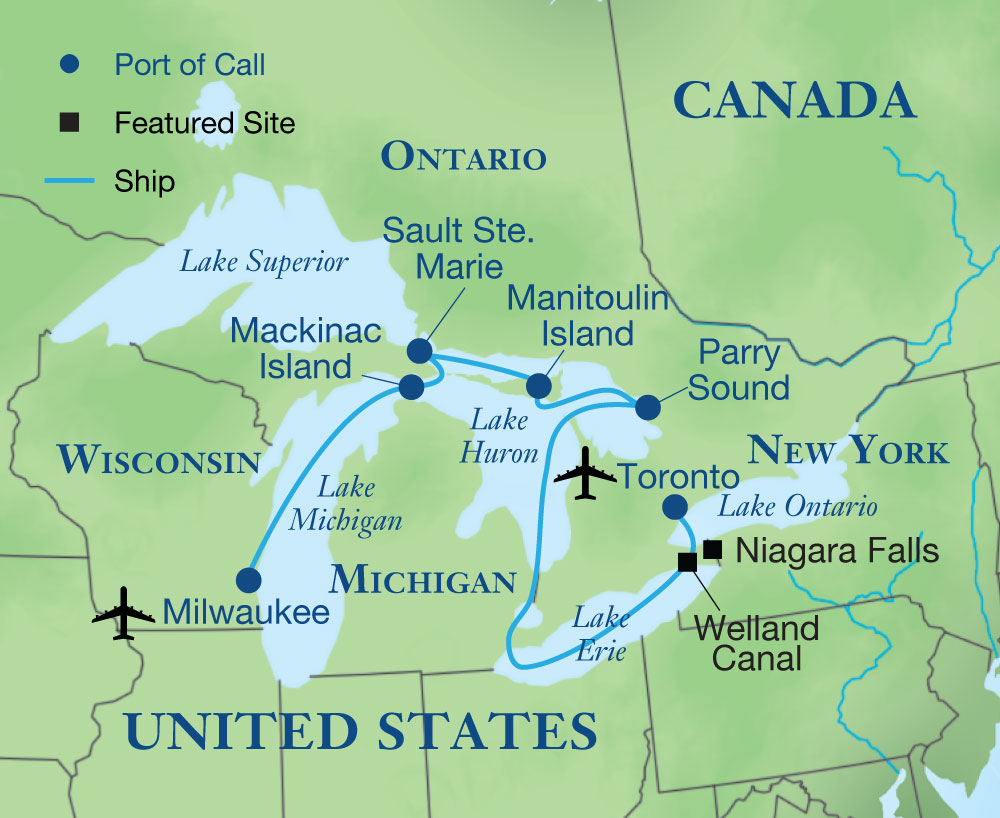
Aug 19–27, 2026: Milwaukee to Toronto
Day 1 — Milwaukee, Wisconsin
Board the ship in Milwaukee, nestled on the shores of Lake Michigan, and settle into your cabin. (B)
Day 2 — Mackinac Island, Michigan, and Lake Michigan
Step back in time on tiny Mackinac Island, a former fur trading center located between Michigan’s Upper and Lower Peninsula. Originally inhabited by American Indians, then occupied by French and British colonists, this island still retains an atmosphere of yesteryear, with Victorian-style buildings and elegant horse-drawn carriages. Climb aboard a horse-drawn carriage for a guided tour of the island. View the iconic Grand Hotel, which has hosted five U.S. presidents, Thomas Edison, and Mark Twain. Enjoy breathtaking views of Lake Huron from Arch Rock. Then venture into the living museum of Fort Mackinac, the site of an important battle during the War of 1812. See exhibits and re-enactments that illustrate what life was like for the families who lived in this army outpost. This afternoon, sail Lake Michigan past cliffs, beaches, and dunes as far as the eye can see. (B,L,D)
Day 3 — Sault Ste. Marie
Located on the northern coast of Michigan’s Upper Peninsula, Sault Ste. Marie is one of the oldest cities in the United States. After passing through passport control, embark on one of two excursions. Take a scenic drive to Tahquamenon Falls State Park for a visit to the stunning Upper and Lower Falls and enjoy a leisurely forest walk. Continue to the Great Lakes Shipwreck Museum to learn about the maritime history of the area. Visit the lightkeeper's quarters at Whitefish Point Light Station, and if you wish, climb the lighthouse tower, in continuous operation for 155 years.
Or drive to the Sault Lock Viewing Station and Interpretive Center to experience the engineering marvel of the Soo Locks. Visit the Valley Camp Museum Ship, a freighter that served on the Great Lakes for almost 50 years. Its massive cargo holds now contain 20,000 square feet of exhibits, displaying artifacts, paintings, and other items related to the maritime history of Lake Superior. Then board a chartered SOO Locks boat for a cruise to the Soo Locks, where your boat is raised 21 feet to enable it to enter Lake Superior. Return to the harbor via the historic Canadian Lock, and sail past St. Mary’s rapids to Sault Ste. Marie. (B,L,D)
Day 4 — Little Current and Manitoulin Island, Ontario, Canada
Little Current is the gateway to Manitoulin Island, the largest freshwater island in the world. Get acquainted with the indigenous Ojibwe people, part of the M’Chigeeng First Nation. Visit the excellent exhibition and art gallery at the Ojibwe Cultural Foundation and see traditional crafts like bead working and making dreamcatchers. Take part in a smudging ceremony (a cleansing and healing ritual) and watch a demonstration of a traditional powwow, a Native American social event featuring dances, music, and other activities. Enjoy free time in Little Current to stroll the waterfront.
Or hike the Cup and Saucer Trail to the highest point on the island—about 1,160 feet—and take in incredible views across forests and lakes. Then sample a selection of Canadian wines, beers, and cheeses, along with locally smoked rainbow trout and whitefish. Alternatively, head to the village of Kagawong for a kayaking expedition on the upper Kagawong River. Paddle calm waters through wetlands and keep your eye out for wildlife. Walk a riverside trail to the viewing platform for Bridal Veil Falls, and stop at a family-owned chocolate business for a cup of hot cocoa or coffee and a chocolate tasting. (B,L,D)
Day 5 — Lake Huron: Parry Sound and Georgian Bay
One of the largest freshwater lakes in the world, Lake Huron separates Michigan from Ontario. Its bays and channels offer a variety of coastal landscapes, from lush woodlands and rocky crags to spectacular cliffs. Dock in Parry Sound and set out on the excursion of your choice. Cruise Georgian Bay aboard the specially designed Island Queen, exploring The Thirty Thousand Islands, the largest freshwater archipelago in the world. Navigate this maze of bays, inlets, sounds, and shoals that lie along the southern edge of the Precambrian Canadian Shield. The captain will maneuver close to the islands, allowing for great views of their forests, wetlands, and rocks, as well as their rich flora and fauna. Alternatively, visit Killbear Provincial Park, a UNESCO Biosphere Reserve on the eastern shores of Georgian Bay. On a nature walk, learn about the park's unusual geology and learn to read the signs of glacial scouring. Discover beaches, rugged shorelines, windswept pines, and take in views of The Thirty Thousand Islands. Learn more about the area’s biodiversity at the visitor center. (B,L,D)
Day 6 — Sailing the St. Clair River to Detroit, Michigan
Cruise the St. Clair River, which was used by French fur traders in the 18th century to facilitate trade with American Indian tribes. More recently, it has served as integral part of the Great Lakes Waterway, a conduit for freighters transporting lumber, iron ore, and copper from the Great Lakes region to the cities of the Rust Belt. Continue onto the Detroit River and sail right through Detroit. Enjoy panoramic views of the skyscrapers of Motor City, where Henry Ford revolutionized the automobile industry and Motown was born. Admire the Ambassador Bridge, which spans the river—and two countries. This steel suspension bridge, more than a mile long, was constructed in 1929 and today carries more than 25% of trade between the United States and Canada. (B,L,D)
Day 7 — Niagara Falls, New York, and Port Colborne, Ontario
Cross Lake Erie to Port Colborne, and set out for one of the most famous sites in North America: Niagara Falls, a group of three waterfalls that straddle the border between Ontario and New York. Pass through Chippawa, site of an important battle in the War of 1812, on the drive to the falls. Then board a specially designed vessel for an exhilarating ride to within feet of Horseshoe Falls, the largest and most powerful of the three falls. (B,L,D)
Day 8 — Welland Canal
Enter the Welland Canal, known for its 1,377-foot lock, one of the world's longest. Originally built in 1829 and later expanded, the canal opened a shipping route between Lake Ontario and Lake Erie. Enjoy a leisurely day on board, watching as the ship is lowered 326 feet on its way through the eight locks. (B,L,D)
Day 9 — Toronto, Ontario, Canada
Disembark in cosmopolitan Toronto, Canada’s largest city, and transfer to the airport for your flight home. (D)
Included meals are denoted as follows: Breakfast (B), Lunch (L), Reception (R), Dinner (D)
Optional Extensions
Aug 11, 2026 Pre-Cruise Ext.: Toronto
Cosmopolitan Toronto — 2 days, 1 night
The itinerary below applies to the current year and serves as a sample for future voyages. Extension details for future departures will be posted as soon as they are available, and all booked travelers will be notified via email.
Toronto is Canada’s largest city and well worth a day of exploration. Take advantage of a specially designed program to get acquainted with some of the highlights of this vibrant, multicultural city on the shores of Lake Ontario.
Day 1 — Toronto, Ontario, Canada
Arrive at Toronto's Pearson International Airport, where you will be met and transferred to the Fairmont Royal York hotel. A local representative will be present at the hospitality desk in the afternoon to welcome you and to offer suggestions for dining and independent exploration. In the evening, join fellow travelers for a welcome reception. Dinner is on your own.
Day 2 — Toronto | Embark
After breakfast and check-out, your guide and driver will meet you at the hotel to accompany your discovery of Toronto. Begin with a panoramic tour of the central city, including University Avenue, the Legislative Building, the Theater District, and City Hall, ending at the Art Gallery of Ontario, one of Toronto's finest museums. A docent-led tour will introduce you to the museum's preeminent permanent exhibition—the oft-awarded McLean Centre for Indigenous & Canadian Art. After the tour, enjoy time to look around on your own or visit the extensive gift shop.
From the museum, drive to Toronto's emblematic CN Tower, where glass-enclosed elevators take you to the top floor for lunch at the 360 Restaurant, which provides constantly changing views of the city from a vantage point more than 1,000 feet above street level, as the restaurant completes a full revolution every 72 minutes. After your meal, enjoy time at leisure to visit the Observation Deck, before returning to the ground to drive along the waterfront to the Toronto Cruise Terminal, where you board your ship.
Your hotel:
The Fairmont Royal York, Toronto’s landmark hotel, is located in the heart of Old Toronto. Recently revitalized, the Fairmont offers all of the facilities and services one would expect from a luxury hotel in a world-class city, including two restaurants and access to a health club, spa, and pool.
Your program includes:
- 1 night at the Fairmont Royal York
- Transfer and luggage handling from the airport to the hotel on the scheduled program arrival day
- Transfer and luggage handling from the hotel to the ship on embarkation day
- Welcome reception on Day 1
- Breakfast and Lunch on Day 2
- Sightseeing and programming as noted in the itinerary
- Local English-speaking guide
- Gratuities for the drivers and local guides
Your program does not include:
- Transfer from the airport to the hotel on any day other than the scheduled program arrival day
- Personal expenses and other services and meals not mentioned as included in the program
Please note:
- It is imperative that your flight arrival details are communicated at least 60 days prior to the beginning of your cruise in order to secure your transfer from the airport to the hotel.
- Early check-in and/or late check-out are available depending on availability and at a supplement. An additional night is possible, upon request and depending on hotel availability. Please, contact reservations or your travel agent for further details.
- The official currency is the Canadian dollar. Credit cards are widely accepted in hotels, shops, and restaurants.
- This pre-cruise program is offered as a package. There will be no refunds for unused accommodations, meals, or excursions.
- Program is offered on a space available basis.
- Program is subject to change without notice.
Aug 19, 2026 Pre-Cruise Ext.: Milwaukee
Milwaukee Highlights — 3 days, 2 nights
The itinerary below applies to the current year and serves as a sample for future voyages. Extension details for future departures will be posted as soon as they are available, and all booked travelers will be notified via email.
Pre-Cruise Program:
This specially curated pre-cruise program is designed to acquaint you with some of the special charms of Milwaukee, a major American city with a proud history created by the labor of waves of immigrants, many from Central Europe. A panoramic tour on the first morning serves to orient you to Milwaukee and its neighborhoods, while an excursion on the following day starts with a visit to Milwaukee's first-class art museum and ends with an introduction to some of the culinary delights for which the city is known—a perfect beginning to your voyage in the Great Lakes.
Day 1 — Milwaukee
Arrive at the Milwaukee airport, where you will be met and transferred to the Pfister Hotel, your home for the next two nights. A local representative will be available at our hospitality desk to welcome you and answer any questions you may have. This evening, gather with fellow travelers for a Welcome Reception in the hotel. Dinner is independent.
Day 2 — Milwaukee
After breakfast at the hotel, meet your guide for a panoramic tour of Milwaukee and visits to several of its most important landmarks. Begin with a narrated drive through the city's neighborhoods and along the Lake Michigan shoreline, stopping briefly for a treat at a local historic bakery before heading to the Harley-Davidson Museum Campus, where you are free to stroll the grounds on your own, learning about Harley-Davidson through interactive displays and seeing legendary bikes, including the original "serial number one." Stop next at Pabst Mansion, the opulent former home of beer baron Frederick Pabst, and tour the richly furnished rooms that testify to the luxury enjoyed by Milwaukee's brewers in the Gilded Age.
The final stop on the tour is at Milwaukee Public Market, a center of shops, galleries, and food vendors. Grab an independent lunch here before driving back to the hotel. Or you may want to stay longer and return to the hotel on foot (less than half a mile). The balance of the day is at leisure. Dinner is independent.
Day 3 — Milwaukee | Embark
After breakfast and check-out, travel to the nearby Milwaukee Art Museum for a tour of one of the Midwest's best collections. The Museum is itself a work of art, featuring a dramatic atrium pavilion designed by Santiago Calatrava with giant "wings" that open and close to the sky. A docent will lead you through the museum's main galleries with works by artists like Winslow Homer and Claude Monet, as well as a large selection of Georgia O'Keeffe paintings. After this guided introduction, enjoy time at leisure to explore the museum on your own, perhaps visiting the modern and contemporary wing with works by Warhol, Miró, Rothko, and Johns.
Leaving the museum, set off on an afternoon exploring Milwaukee cuisine. Begin at the Hill Valley Dairy Bar to sample their award-winning locally crafted cheeses paired with a small-batch spirit cocktail. Then head downtown for lunch at Mader's Restaurant, a landmark of German cuisine since the turn of the 20th century. Following lunch, stretch your legs with a walk through the Deer District, Milwaukee’s buzzing downtown hub, home to the Milwaukee Bucks and public art displays, before ending your tour with a scoop of the frozen custard for which Wisconsin is famous. After this culinary journey, transfer to the pier to embark Le Bellot and set sail.
Your hotel:
Since its opening in 1893 in downtown Milwaukee, the Pfister Hotel has been an iconic landmark—"The Grand Hotel of the West." The hotel's lobby is a 3-story atrium with marble staircase, massive fireplace, and frescoed ceiling. In addition to the original building, which is listed on the National Register of Historic Places, the Pfister features a modern 23-story tower, fitness studio, indoor pool, spa, and a cocktail lounge on the top floor, with views of the skyline and Lake Michigan. The hotel has been awarded AAA's prestigious Four-Diamond status since 1978.
Your program includes:
- 2 nights at the Pfister Hotel (or similar)
- Transfer and luggage handling from the airport to the hotel on the scheduled program arrival day
- Transfer and luggage handling from the hotel to the ship on the day of embarkation
- Welcome Reception on Day 1
- Breakfast on days 2 and 3
- Lunch on Day 3
- Sightseeing and programming as noted in the itinerary
- Local English-speaking guide
- Gratuities for the drivers and local guides
Your program does not include:
- Transfer from the airport to the hotel on any day other than the scheduled program departure day
- Personal expenses and other services and meals not mentioned as included in the program
Please note:
- It is imperative that your flight arrival details are communicated at least 60 days prior to the beginning of your cruise in order to secure your transfer from the airport to the hotel.
- Early check-in can be arranged, depending on availability and at a supplement. An additional night is possible, upon request and depending on hotel availability. Please, contact reservations or your travel agent for further details.
- This pre-cruise program is offered as a package. There will be no refunds for unused accommodations, meals, or excursions.
- Program is offered on a space available basis.
- Program is subject to change without notice.
Aug 19, 2026 Post-Cruise Ext.: Toronto
Cosmopolitan Toronto — 2 days, 1 night
The itinerary below applies to the current year and serves as a sample for future voyages. Extension details for future departures will be posted as soon as they are available, and all booked travelers will be notified via email.
Post-Cruise Program:
Toronto is Canada’s largest city and well worth a full day of exploration. Take advantage of a specially designed program to get acquainted with this vibrant, multicultural city on the shores of Lake Ontario.
Day 1 — Disembark | Toronto, Ontario, Canada
After breakfast and disembarkation, your guide and driver will meet you at the pier to accompany your discovery of Toronto. Begin with a panoramic tour of the central city, including University Avenue, the Legislative Building, the Theater District, and City Hall, ending at the Art Gallery of Ontario, one of Toronto's finest museums. A docent-led tour will introduce you to the museum's preeminent permanent exhibition—the oft-awarded McLean Centre for Indigenous & Canadian Art. After the tour, enjoy time to look around on your own or visit the extensive gift shop.
From the museum, drive to Toronto's emblematic CN Tower, where glass-enclosed elevators take you to the top floor for lunch at the 360 Restaurant, which provides constantly changing views of the city from a vantage point more than 1,000 feet above street level, as the restaurant completes a full revolution every 72 minutes. After your meal, enjoy time at leisure to visit the Observation Deck, before returning to the ground to drive to the Fairmont Royal York hotel, where you check in for overnight. Dinner this evening is independent.
Day 2 — Toronto
Following breakfast at your hotel, transfer to Toronto’s Pearson International Airport for flights homeward.
Your hotel:
The Fairmont Royal York, Toronto’s landmark hotel, is located in the heart of Old Toronto. Recently revitalized, the Fairmont offers all of the facilities and services one would expect from a luxury hotel in a world-class city, including two restaurants and access to a health club, spa, and pool.
Your program includes:
- 1 night at the Fairmont Royal York
- Sightseeing and programming as noted in the itinerary
- Transfer and luggage handling from the ship to the hotel
- Local English-speaking guide
- Lunch on Day 1
- Breakfast on Day 2
- Transfer and luggage handling from the hotel to the airport on the scheduled program departure day
- Gratuities for the drivers and local guides
Your program does not include:
- Transfer from the hotel to the airport on any day other than the scheduled program departure day
- Personal expenses and other services and meals not mentioned as included in the program
Please note:
- It is imperative that your flight departure details are communicated at least 60 days prior to the beginning of your cruise in order to secure your transfer from the hotel to the airport.
- Early check-in and/or late check-out are available depending on availability and at a supplement. An additional night is possible, upon request and depending on hotel availability. Please, contact reservations or your travel agent for further details.
- The official currency is the Canadian dollar. Credit cards are widely accepted in hotels, shops, and restaurants.
- This post-cruise program is offered as a package. There will be no refunds for unused accommodations, meals, or excursions.
- Program is offered on a space available basis.
- Program is subject to change without notice. Order of sightseeing may vary.
Dates & Prices
Click on the departure date to see pricing. Click the for more information.
Dates
Availability
Price
Aug 11 - 19, 2026
Call to Join Waitlist
from $12,630 $10,770
Special Offer
Early booking savings available for a limited time!
Deluxe Stateroom
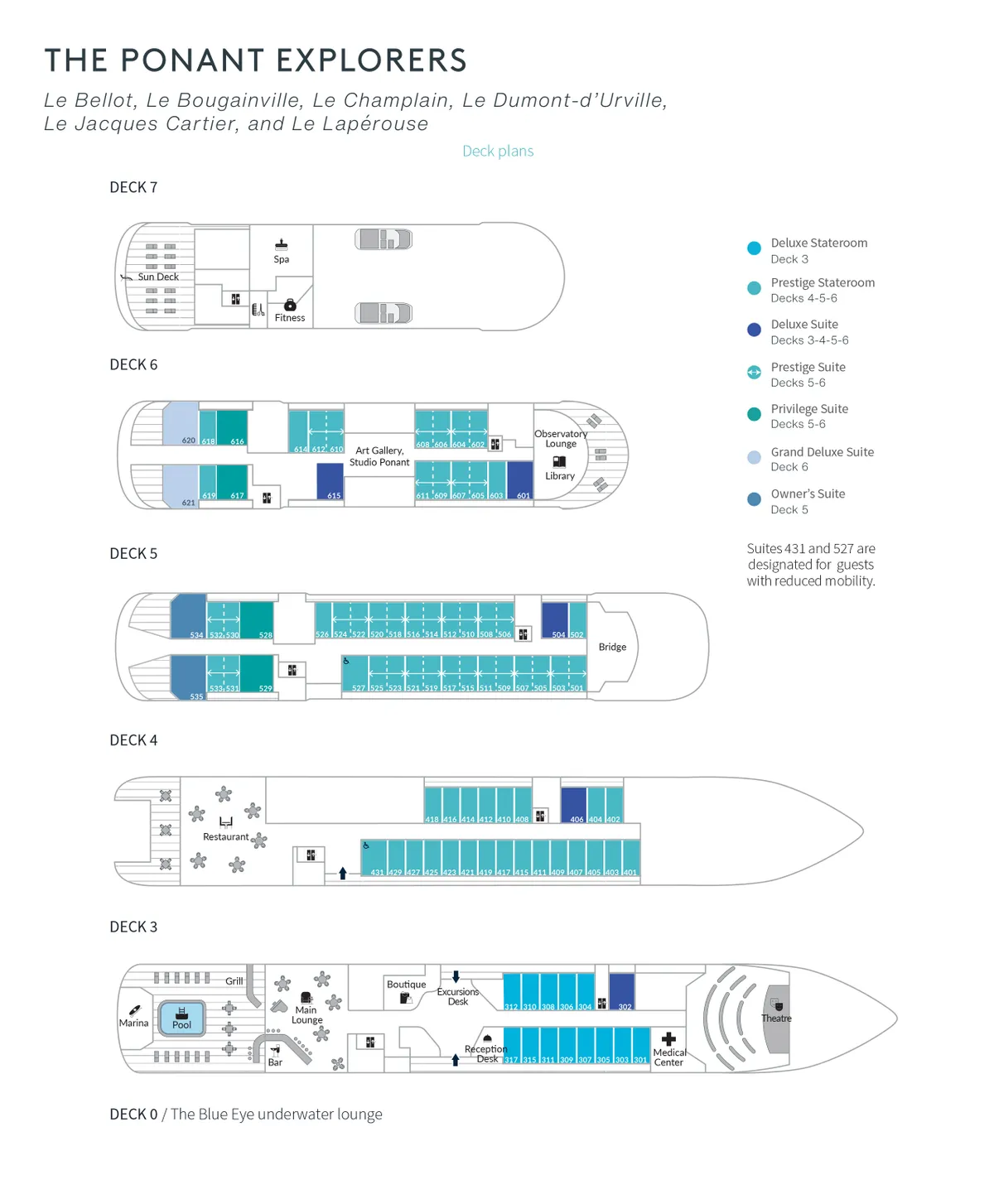
Deluxe stateroom (204 sq. ft.), picture window with door onto private partial wall balcony (43 sq. ft.). Deck 3.
| Occupancy | Double | Single |
|---|---|---|
| Price | $12,630 $10,770 | $24,320 $13,750 |
| Pre Ext. | $1,230 | $1,490 |
Prestige Stateroom - Deck 4
Prestige stateroom (204 sq. ft.), sliding glass door opens to private balcony (43 sq. ft.).
| Occupancy | Double | Single |
|---|---|---|
| Price | $13,980 $11,920 | $27,020 $15,240 |
| Pre Ext. | $1,230 | $1,490 |
Prestige Stateroom - Deck 5
Prestige stateroom (204 sq. ft.), sliding glass door opens to private balcony (43 sq. ft.).
| Occupancy | Double | Single |
|---|---|---|
| Price | $14,660 $12,500 | $28,380 $15,990 |
| Pre Ext. | $1,230 | $1,490 |
Prestige Stateroom - Deck 6
Prestige stateroom (204 sq. ft.), sliding glass door opens to private balcony (43 sq. ft.).
| Occupancy | Double | Single |
|---|---|---|
| Price | $15,470 $13,190 | $30,000 $16,890 |
| Pre Ext. | $1,230 | $1,490 |
Deluxe Suite
Deluxe suite (291 sq. ft.), sliding glass door to private balcony (65 sq. ft.), sitting area with sofa. Decks 3, 4, 5, and 6.
| Occupancy | Double | Single |
|---|---|---|
| Price | $21,420 $18,240 | $41,900 $23,460 |
| Pre Ext. | $1,230 | $1,490 |
Prestige Suite - Deck 5
Prestige suite, two room suite (409 sq. ft.), sliding glass door to larger private balcony (86 sq. ft.), two bathrooms, sitting area and sofa convertible to fixed queen.
| Occupancy | Double | Single |
|---|---|---|
| Price | $28,850 $24,560 | $56,760 $31,670 |
| Pre Ext. | $1,230 | $1,490 |
Prestige Suite - Deck 6
Prestige suite, two room suite (409 sq. ft.), sliding glass door to larger private balcony (86 sq. ft.), two bathrooms, sitting area and sofa convertible to fixed queen.
| Occupancy | Double | Single |
|---|---|---|
| Price | $30,340 $25,830 | $59,740 $33,320 |
| Pre Ext. | $1,230 | $1,490 |
Privilege Suite
Privilege suite, (344 sq. ft.), sliding glass door to larger private balcony (86 sq. ft.), sitting area with sofa convertible to single twin. Decks 5 and 6.
| Occupancy | Double | Single |
|---|---|---|
| Price | $31,830 $28,640 | $62,720 $28,640 |
| Pre Ext. | $1,230 | $1,490 |
Grand Deluxe Suite
Grand Deluxe suite, extra large two room suite (484 sq. ft.), sliding glass door to spacious private terrace (323 sq. ft.), a large sitting area with half bath, master bedroom has a separate shower, tub, and double sinks. Deck 6.
| Occupancy | Double | Single |
|---|---|---|
| Price | $34,940 $31,440 | $68,940 $31,440 |
| Pre Ext. | $1,230 | $1,490 |
Owner's Suite
Owner's suite, extra large two room suite (484 sq. ft), sliding glass door to spacious private terrace (430 sq. ft.) with outdoor hot tub. Large sitting area with half bath, master bathroom has a separate shower, tub, and double sinks. Deck 5.
| Occupancy | Double | Single |
|---|---|---|
| Price | $36,700 | $72,460 |
| Pre Ext. | $1,230 | $1,490 |
Aug 19 - 27, 2026
Available
from $12,610 $11,340
Special Offer
No Single Supplement for solo travelers on most categories!
Early booking savings available for a limited time!
Deluxe Stateroom
Deluxe stateroom (204 sq. ft.), picture window with door onto private partial wall balcony (43 sq. ft.). Deck 3.
| Occupancy | Double | Single |
|---|---|---|
| Price | $12,610 $11,340 | $24,300 $11,340 |
| Pre Ext. | $1,560 | $2,020 |
| Post Ext. | $950 | $1,220 |
Prestige Stateroom - Deck 4
Prestige stateroom (204 sq. ft.), sliding glass door opens to private balcony (43 sq. ft.).
| Occupancy | Double | Single |
|---|---|---|
| Price | $13,960 $12,550 | $27,000 $12,550 |
| Pre Ext. | $1,560 | $2,020 |
| Post Ext. | $950 | $1,220 |
Prestige Stateroom - Deck 5
Prestige stateroom (204 sq. ft.), sliding glass door opens to private balcony (43 sq. ft.).
| Occupancy | Double | Single |
|---|---|---|
| Price | $14,640 $13,160 | $28,360 $13,160 |
| Pre Ext. | $1,560 | $2,020 |
| Post Ext. | $950 | $1,220 |
Prestige Stateroom - Deck 6
Prestige stateroom (204 sq. ft.), sliding glass door opens to private balcony (43 sq. ft.).
| Occupancy | Double | Single |
|---|---|---|
| Price | $15,450 $13,890 | $29,980 $13,890 |
| Pre Ext. | $1,560 | $2,020 |
| Post Ext. | $950 | $1,220 |
Deluxe Suite
Deluxe suite (291 sq. ft.), sliding glass door to private balcony (65 sq. ft.), sitting area with sofa. Decks 3, 4, 5, and 6.
| Occupancy | Double | Single |
|---|---|---|
| Price | $21,400 $19,250 | $41,880 $19,250 |
| Pre Ext. | $1,560 | $2,020 |
| Post Ext. | $950 | $1,220 |
Prestige Suite - Deck 5
Prestige suite, two room suite (409 sq. ft.), sliding glass door to larger private balcony (86 sq. ft.), two bathrooms, sitting area and sofa convertible to fixed queen.
| Occupancy | Double | Single |
|---|---|---|
| Price | $28,830 $25,930 | $56,740 $25,930 |
| Pre Ext. | $1,560 | $2,020 |
| Post Ext. | $950 | $1,220 |
Prestige Suite - Deck 6
Prestige suite, two room suite (409 sq. ft.), sliding glass door to larger private balcony (86 sq. ft.), two bathrooms, sitting area and sofa convertible to fixed queen.
| Occupancy | Double | Single |
|---|---|---|
| Price | $30,320 $27,280 | $59,720 $27,280 |
| Pre Ext. | $1,560 | $2,020 |
| Post Ext. | $950 | $1,220 |
Privilege Suite
Privilege suite, (344 sq. ft.), sliding glass door to larger private balcony (86 sq. ft.), sitting area with sofa convertible to single twin. Decks 5 and 6.
| Occupancy | Double | Single |
|---|---|---|
| Price | $31,810 $28,620 | $62,700 $28,620 |
| Pre Ext. | $1,560 | $2,020 |
| Post Ext. | $950 | $1,220 |
Grand Deluxe Suite
Grand Deluxe suite, extra large two room suite (484 sq. ft.), sliding glass door to spacious private terrace (323 sq. ft.), a large sitting area with half bath, master bedroom has a separate shower, tub, and double sinks. Deck 6.
| Occupancy | Double | Single |
|---|---|---|
| Price | $34,920 $31,420 | $68,920 $31,420 |
| Pre Ext. | $1,560 | $2,020 |
| Post Ext. | $950 | $1,220 |
Owner's Suite
Owner's suite, extra large two room suite (484 sq. ft), sliding glass door to spacious private terrace (430 sq. ft.) with outdoor hot tub. Large sitting area with half bath, master bathroom has a separate shower, tub, and double sinks. Deck 5.
| Occupancy | Double | Single |
|---|---|---|
| Price | $36,680 | $72,440 |
| Pre Ext. | $1,560 | $2,020 |
| Post Ext. | $950 | $1,220 |
A deposit of 25% of the cruise price is required to reserve space on a cruise. Deposits are applied toward final payment of the cruise price.
Rates include port taxes and fees. Most shore excursions are included in the rates.
Pre- and post-program options and optional excursions, where applicable, are available at an additional cost.
Prices are based on rates of exchange, airfare & fuel (where applicable), tariffs, taxes, and other costs as of the tour publication date. We reserve the right to correct errors and to increase program prices to cover increased costs, tariffs, and taxes received after prices are published and to reflect currency fluctuations.
/https://tf-cmsv2-journeys-media.s3.amazonaws.com/filer_public/ba/3d/ba3dd6dc-eba4-45d0-9852-9d16be5f7e53/mi_soolocks_saultstmarie_ss_505483051.jpg)
Experts
/https://tf-cmsv2-journeys-media.s3.amazonaws.com/journeys/expert/Montgomery_Wren.jpg)
Wren Montgomery
Environment & Sustainability Specialist
Dr. Wren Montgomery is Quinn Professor of Sustainability, Smith School of Business, Queen’s University, in Kingston Ontario. She is also a faculty affiliate at the …
Dr. Wren Montgomery is Quinn Professor of Sustainability, Smith School of Business, Queen’s University, in Kingston Ontario. She is also a faculty affiliate at the University of Michigan’s Erb Institute for Sustainable Enterprise and a 2024-25 faculty fellow at Stanford University.
Wren grew up on the shores of the Great Lakes and St. Lawrence as a swimmer, sailor, kayaker, and lifeguard and loves being in and on the water. Her academic career has been driven by her love of water and the natural environment. She is known for her award-winning research on the Detroit waters shutoffs, the human right to water, and clean water access and affordability challenges. Wren also researches how companies communicate about their environmental activities. Her work on greenwashing (companies who exaggerate their sustainability efforts) has been pivotal in defining greenwash and its tactics and informing global strategies and policies to stop it.
As a life-long learner herself, Wren believes it is vital to share and co-create academic research with the public. She is frequently featured in prominent media outlets such as The Globe and Mail, The Guardian, CBC Marketplace and The Current, Bloomberg News, Consumer Reports and The Washington Post, among many others. Dr. Montgomery also co-founded the Greenwash Action Lab to make her academic research and insights accessible to the public and is working on a new book project with Stanford University Press, Beating the Greenwashers. Wren is also honoured to serve as a board member for the Alliance for the Great Lakes and for a Silicon Valley-based water efficiency start-up.
+ Show more
/https://tf-cmsv2-journeys-media.s3.amazonaws.com/journeys/expert/Roorda_Eric_2023.jpg)
Eric Roorda
Maritime Historian & Author
Eric Paul Roorda is a maritime historian, author, and artist. A native of the Great Lakes region, he recently retired from 30 years of teaching …
Eric Paul Roorda is a maritime historian, author, and artist. A native of the Great Lakes region, he recently retired from 30 years of teaching for Johns Hopkins University, Williams College, and Mystic Seaport Museum, among other places. His most recent books include The Ocean Reader: History, Politics, Culture (2020), Cats At Sea, A to Z (2019), and Twain At Sea: The Maritime Writings of Samuel Langhorne Clemens (2018). He received his education at the College of William and Mary and Johns Hopkins University.
Eric comes from a seafaring family in Holland: his grandfather was a first engineer in the Dutch Merchant Marine whose ships were sunk twice during World War I, and his great-grandfather worked on Zuiderzee ferries.
+ Show more
/https://tf-cmsv2-journeys-media.s3.amazonaws.com/journeys/expert/Edgerton_Keith.jpg)
Keith Edgerton
Historian
Keith Edgerton is professor emeritus at Montana State University-Billings, teaching in the Montana university system for 34 years, the final 29 of those at MSU-Billings. …
Keith Edgerton is professor emeritus at Montana State University-Billings, teaching in the Montana university system for 34 years, the final 29 of those at MSU-Billings. He holds a B.A. and M.A. in history from the University of Montana and a Ph.D. in American Studies from Washington State University. Upon his retirement in 2023 he was recognized by MSU-Billings with the institution’s “Lifetime Achievement Award.”
Over his career he has taught a range courses on early American history, American Environmental history, and Trans-Atlantic history. Throughout his career he has spoken on a variety of historical topics to diverse audiences and has led a number of Smithsonian adventures, including on the Great Lakes, into the American Southwest, along the Columbia River, and through Vietnam.
Dr. Edgerton has written and published extensively on a range of subjects. He is the author of Montana Justice: Power, Punishment, and the Penitentiary published by the University of Washington Press in 2005. Currently he is at work on a biography of William A. Clark (not to be confused with the William Clark of Lewis and Clark fame). This particular William A. Clark was one of Montana’s late 19th century copper barons and became a U.S. Senator in 1901 in an election tainted by, to put it mildly, scandal and corruption. When he died in New York in 1925 he was one of the wealthiest individuals in the world.
Keith splits his time between Billings and Missoula with his “amore” and wife, Lenette Kosovich. They love to cook, travel, make home brew, and in the summer canoe through the scenic White Cliffs region of the upper Missouri river in Montana. Between them they have five sons in various states of adulthood.
+ Show more
/https://tf-cmsv2-journeys-media.s3.amazonaws.com/journeys/expert/fred_stonehouse22.jpg)
Frederick Stonehouse
Maritime Historian & Author
Frederick Stonehouse is the author of over thirty books on maritime history many focusing on the Great Lakes including the best selling The Wreck of the Edmund Fitzgerald. He has been a consultant for both the U.S. National Park Service and Parks Canada and has been an "on-air" expert for National Geographic and History Channel as well as many regional media productions.
Awards include the 2006 Association for Great Lakes Maritime History Award for Historic Interpretation, Historical Society of Detroit’s 2007 Historian of the Year, 2017 Great Lakes Shipwreck Preservation Society C. Patrick Labadie Special Acknowledgement Award, Northern Michigan University 2014 Distinguished Alumna Award, 2018 “Governor’s Special Tribute” (Michigan) and 2019 Historical Society of Michigan Follo Award.
His knowledge of sailing our itinerary as a Coast Guard licensed mariner and academic credentials provide a unique perspective for our voyage. Forty years of Great Lakes shipwreck diving and searching adds a practical viewpoint of Great Lakes maritime history. Several of his books relate directly to waters we sail and ports visited.
Fred teaches Great Lakes maritime history at Northern Michigan University and is an active consultant for numerous maritime projects and programs. He is past President of the National Board of Directors of the U.S. Life-Saving Service Heritage Association and past Vice Chair (Policy) of the Michigan Port Collaborative. Fred makes his home in Marquette, Michigan. For more information: www.frederickstonehouse.com.
+ Show more
/https://tf-cmsv2-journeys-media.s3.amazonaws.com/journeys/expert/David_Catlin_181124.JPG)
David Catlin
Naturalist & Educator
David Catlin has spent his professional career helping people connect to special places, especially natural ones. Over the last 45 years, he has worked as …
David Catlin has spent his professional career helping people connect to special places, especially natural ones. Over the last 45 years, he has worked as a naturalist and educator for the National Park Service, the U.S. Fish & Wildlife Service, the Missouri Department of Conservation, and the National Audubon Society. Catlin was born and raised in Detroit and has traveled widely, with a special affinity for places in the U.S. and Canada that are “off the beaten path.” One of his favorite haunts is the Canadian Maritime provinces. He has special interests in birds, traditional acoustic music, and lighthouses.
Catlin has degrees in environmental education and interpretation from Michigan State University and the University of Washington. He currently lives in Springfield, Missouri, with his wife Ann, and works nationwide as a consultant to nature centers and other environmental learning institutions.
+ Show more
/https://tf-cmsv2-journeys-media.s3.amazonaws.com/journeys/expert/Sowden_Carrie.jpg)
Carrie Sowden
Archaeologist
Carrie Sowden is the director of archaeology and research at the National Museum of the Great Lakes in Toledo, Ohio, and served as a leader …
Carrie Sowden is the director of archaeology and research at the National Museum of the Great Lakes in Toledo, Ohio, and served as a leader on the team that created and built the museum in 2014. Since 2004, she has worked on many shipwreck projects across Lake Erie as well as Lake Ontario and Lake Huron. Part of her focus is working with volunteers, teaching the techniques and purpose behind the study of submerged cultural history in the Great Lakes. Carrie earned a BS in chemistry from Emory University and a master’s in anthropology and nautical archaeology from Texas A&M University.
+ Show more
/https://tf-cmsv2-journeys-media.s3.amazonaws.com/journeys/expert/Stone_Joel.jpg)
Joel Stone
Maritime Historian & Curator
Joel Stone has enjoyed a lifetime dedicated to societal enrichment through historical and cultural preservation and engagement. He is a native Detroiter, and curator emeritus …
Joel Stone has enjoyed a lifetime dedicated to societal enrichment through historical and cultural preservation and engagement. He is a native Detroiter, and curator emeritus at the Detroit Historical Society and the Dossin Great Lakes Museum. Stone holds degrees or certificates in communication, history, and archival management, with professional experience in archaeology, exhibition development, and community outreach.
His scholarly and recreational interests are focused on the Great Lakes region, particularly its maritime industry and nineteenth century society. Stone is a past president of the Association for Great Lakes Maritime History, and in 2023 was honored as “Great Lakes Maritime Historian of the Year” by the Marine Historical Society of Detroit. A life-long sailor, Joel has travelled on and around all five freshwater seas.
His award-winning writing and collaborations include “Floating Palaces of the Great Lakes” (University of Michigan Press, 2015), “Detroit1967: Origins, Impacts, Legacies” (Wayne State University Press, 2017), and “Interpreting Maritime History at Museums and Historic Sites” (Rowman & Littlefield, 2017).
+ Show more
/https://tf-cmsv2-journeys-media.s3.amazonaws.com/journeys/expert/Reese_Joseph.png)
Joe Reese
Geologist
Dr. Joe Reese is a recently retired Professor Emeritus of Geology. For 23 years, he was a faculty member in the Department of Biology, Earth and Environmental Sciences at Pennsylvania Western University, Edinboro. Joe was born in Michigan, …
Dr. Joe Reese is a recently retired Professor Emeritus of Geology. For 23 years, he was a faculty member in the Department of Biology, Earth and Environmental Sciences at Pennsylvania Western University, Edinboro. Joe was born in Michigan, the Great Lakes state, and has lived in northwestern Pennsylvania for much of his life, the last 20+ years within a stone’s throw of the Lake Erie shore.
Inspired by boyhood adventures with his father to U.S. national parks and other natural settings, including sojourns to Lake Superior beaches to collect agates, Joe became more than curious about geology. He pursued his master’s degree from the University of Wisconsin-Madison and earned a doctorate from the University of Texas at Austin. He taught a range of undergraduate courses at Edinboro and counts among his favorites Earth history and Tectonics of North America. Earlier in his 30+ year career, he conducted research on continent evolution and the formation of mountains, with the evolution of Laurentia (North America) and the Grenville Province being of special interest. Study of rocks in and around the Great Lakes has been integral to telling these geologic stories.
Later, his interests drifted to Earth-system history and place-based geoscience education. Specifically, over my career, I used imagery from space to study Earth-system processes and environmental changes and explored using local earth systems as means to educate. Post-retirement, he continues to use imagery from space to study Earth-system processes and environmental changes and to explore his local Earth system in northwestern Pennsylvania. Earth systems and environmental issues of the Great Lakes Watershed are a particular focus. Continuing from his boyhood adventures, he has traveled extensively throughout the Great Lakes, visiting and immersing himself in the geology, natural history, human-environment interactions, history, and culture of this region.
Joe is also an avid explorer of the cultural geographic aspects of the craft beer industry, co-authoring pioneering works on the topic. Although geoscience and education are his passion and vocation, he enthusiastically delves into roots music of all sorts, art, travel, hiking, good food and drink, and other such endeavors.
+ Show more
Ship
Le Bellot

/https://tf-cmsv2-journeys-media.s3.amazonaws.com/filer_public/17/ca/17cab84d-735e-480f-a05a-efeafa10f0f9/mi_georgianbay_parrysound_ss_2421349385.jpg)
Tour Details
Activity Description
Expectations: Lake cruise that pulls into a pier for disembarkation via gangway. Morning or afternoon excursions off ship via motor coach or guided walks from pier. Moderate pace. Excursions can be over uneven terrain (e.g. cobblestones, city hills, hiking trails, stairs without handrails, absence of elevators); easy to moderate walks at most sites.
Appropriate for: Travelers who are physically fit and comfortable with longer days of touring (both walking tours and coach time).
Reading List
*As an Amazon Associate, Smithsonian Journeys earns from qualifying purchases.
Learn more about maritime archaeologists's work with 3D scan of a shipwreck in the Great Lakes in Smithsonian Magazine.
Highly Recommended
Also Recommended



Travel Insurance
For the convenience of our travelers, Smithsonian Journeys includes a basic medical expense and evacuation plan through Trip Mate, a Generali Global Assistance & Insurance Services brand, at no additional charge. This plan provides post-departure Medical and Dental coverage of $250,000 per person and Emergency Assistance and Transportation coverage of $1,000,000 per person (U.S. Residents Only). Note: For full details regarding these coverages please review the following Plan Documents here.
In addition, we recommend that travelers purchase a travel protection plan to help protect their travel investment from unforeseen events such as cancellation due to illness, flight delays due to adverse weather, baggage loss, and more. For your convenience, Smithsonian Journeys offers an optional Travel Protection Plan administered by Trip Mate, a Generali Global Assistance & Insurance Services brand. For those interested, optional "Cancel for Any Reason" coverage is available for an additional charge. Note: Certain eligibility requirements apply and Cancel for Any Reason coverage is not available to New York residents. For full details regarding this coverage please review the following Plan Documents here.
To learn more about the Travel Protection Plan, you may visit https://www.generalipartner.com/smithsonianjourneys or call the administrator, Trip Mate, a Generali Global Assistance & Insurance Services brand at (866) 501-3252.
Related Tours
/https://tf-cmsv2-journeys-media.s3.amazonaws.com/filer/35/1d/351d6d03-5b44-4a96-bfeb-761ac453dd84/az_monumentvalley_ist_1147233225.jpg)
Cliffs and Canyons of the American Southwest: A Tailor-Made Journey
9 days
|
from:
$4,290
Suggested Itinerary
/https://tf-cmsv2-journeys-media.s3.amazonaws.com/filer_public/ec/a5/eca58c09-d0c0-470b-a034-6be6e4e88cb3/can_rockies_train_ist-2157189724.jpg)
Vancouver to the Canadian Rockies by Rail: A Tailor-Made Journey
12 days
|
from:
$5,995
Suggested Itinerary
/https://tf-cmsv2-journeys-media.s3.amazonaws.com/filer/9e/77/9e7728b3-aa0c-4872-9fd6-23f29aaf4259/ak_anchorage_dt_l_30285733.jpg)
Alaska: A Tailor-Made Journey featuring an Inside Passage Cruise
12 days
|
from:
$10,280
Suggested Itinerary
/https://tf-cmsv2-journeys-media.s3.amazonaws.com/filer_public/d7/6d/d76d0293-d968-4edd-9d30-7f70a18094d8/sd_badlands_dt96478521.jpg)
/https://tf-cmsv2-journeys-media.s3.amazonaws.com/filer/d9/69/d969c159-8dfe-4eb5-becb-98097e898da2/can_toronto_cityscape_eve_ist_000041607662_large.jpg)
Smithsonian at the Toronto International Film Festival
6 days
|
from:
$5,540
Sep 9 - 14, 2026
Sep 8 - 13, 2027
/https://tf-cmsv2-journeys-media.s3.amazonaws.com/filer_public/a8/2e/a82e594c-2ebf-4100-8756-a063b6ff21b0/la_neworleans_frenchquartercharm_ist_613668804.jpg)
A Stay in New Orleans: History, Music, and Cuisine in the Big Easy
7 days
|
from:
$4,790
Nov 8 - 14, 2026