
/https://tf-cmsv2-journeys-media.s3.amazonaws.com/filer/c4/3a/c43aef58-c115-405e-8e07-a521737c2a01/jpn_kyoto_fushimiinarishrine_geishas_ss_550609591.gif)
Historic Cities of Japan and South Korea: A Journey From Seoul to Tokyo
14 days from $8,990
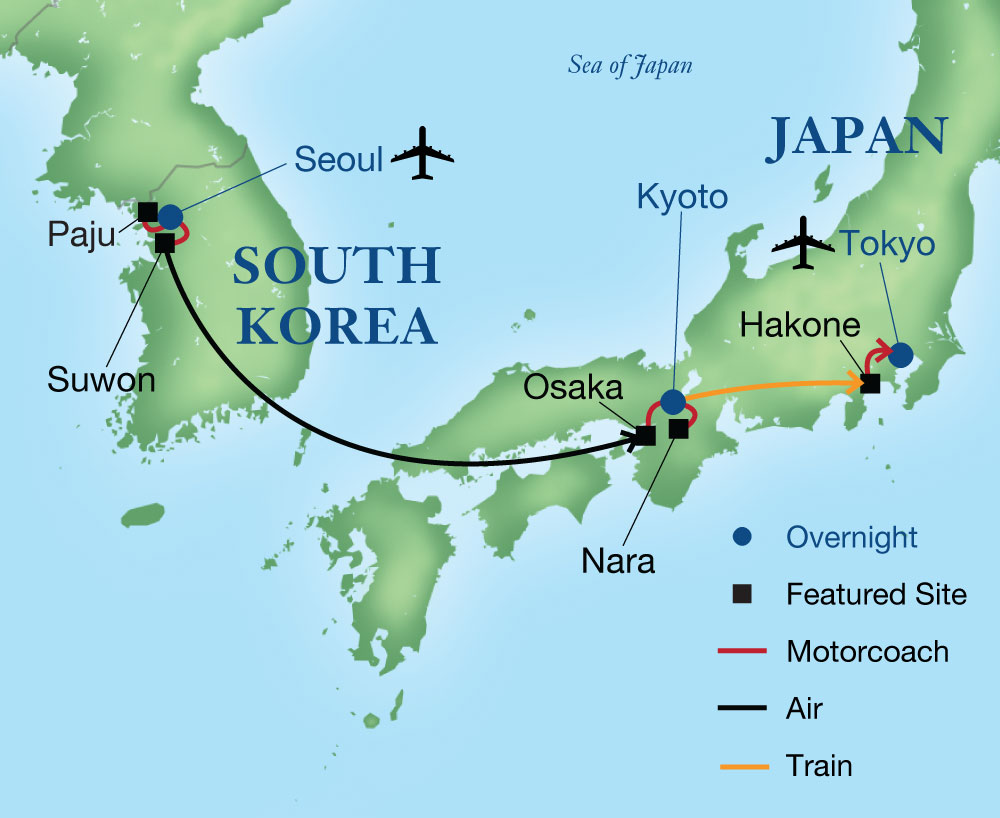
South Korea and Japan are cultural powerhouses whose traditions of cuisine and the arts have infused everyday life all around the world. Delve into the rich heritage of these two nations on a journey to three cities—Seoul, Kyoto, and Tokyo—where the past is palpable amid the exciting buzz of contemporary life. Along the way, visit the DMZ that separates the two Koreas and encounter the perfect peak of Mount Fuji.

Highlights
- Seoul: Delve into the sights and sounds of Seoul, exploring palaces, temples, traditional neighborhoods, and markets. On a day trip to Paju, gaze across the DMZ towards North Korea.
- Kyoto: Tour a range of ancient temples in the World Heritage site of Kyoto—including a nighttime visit of magical Fushimi Inari—and explore the historic capital city of Nara.
- Mount Fuji: Cruise Lake Ashi beneath Mount Fuji’s peak and visit the architecturally fascinating Mount Fuji World Heritage Center. Take advantage of free time to discover charming Hakone.
- Tokyo: Learn the traditions of a Japanese tea ceremony, and visit Tokyo’s oldest shrine, Senso-ji, and its tallest building, the Tokyo Skytree.
- Please Note: Trip price, all accommodations, and an update to Day 6 evening events have been implemented since the printing of our Winter 2026 catalog. See the itinerary, accommodations, and pricing tabs for details.

Itinerary
To see itinerary, please click on an option below.
Days 1–3 — Depart the U.S. for Seoul, South Korea
Depart on an overnight flight to Seoul, crossing the international date line and arriving on Day 3. You’ll be met and assisted with your transfer to your hotel in the city center. Take the remainder of the day to relax and settle in.
Day 4 — Seoul
After breakfast, gather for an introduction to South Korea’s history, culture, and contemporary issues by a local expert. Hear about the historical division of North and South Korea; learn Korean traditions of language, food, and festivals; and discuss the rapid economic growth of South Korea. Then set out for Gyeongbokgung, the main palace of the Joseon dynasty, which ruled Korea from the 1300s to the end of the 19th century. Originally built in 1395, the palace was destroyed and rebuilt several times throughout its history. Meander among its lotus ponds and gardens, and stop in at the National Folk Museum on the palace grounds to view artifacts dating from prehistory to the 20th century.
Next, visit the 600-year-old neighborhood of Bukchon Hanok Village for a closer look at traditional Korean houses called hanok, built with natural materials using ancient principles of architecture and spirituality. After lunch at a local restaurant, stroll through the lively Namdaemun Market for a taste of everyday life. Meet in the evening for a welcome reception and dinner. (B,L,R,D)
Day 5 — Paju and the DMZ
Journey to the town of Paju, situated on the edge of the Demilitarized Zone, or DMZ, separating North and South Korea, a lasting legacy of the Korean War. Learn the history of this heavily fortified buffer zone, and look out toward North Korea from an observation point. Return to Seoul after lunch, and meet up in the Smithsonian Journeys Travelers Corner for an informal discussion about the day’s discoveries with fellow travelers and your expert. During a free evening, explore Seoul’s famous street food scene or try one of the city’s many acclaimed restaurants. (B,L)
Day 6 — Seoul
Venture to Hwaseong, a walled fortress in the nearby town of Suwon that was built by King Jeongjo at the end of the 18th century to house the tomb of the king’s father, Prince Sado. Explore this World Heritage site, where nearly four miles of imposing walls, observation towers and gates surround the town and its palace. Lunch independently before returning to Seoul, where the remainder of the day is at leisure. (B)
Day 7 — Seoul to Kyoto, Japan
A morning flight brings you from Seoul to Osaka, Japan. Transfer to your hotel in Kyoto and enjoy free time to relax this afternoon. In the evening, join your fellow travelers for a special Japanese dinner and geisha performance in the historic Gion district, known for its traditional wooden machiya townhouses. (B,D)
Day 8 — Kyoto
Marvel at a massive torii gate as you approach Heian Jingu shrine, built on the occasion of the 1100th anniversary of Kyoto’s founding as an imperial capital. Then visit Sanju-sangen-do temple, known for its 1001 statues of Kannon, the goddess of mercy in Japanese Buddhism. Continue to the celebrated Kiyomizu Temple, founded in 780 next to a waterfall in the wooded hills east of Kyoto. Watch a demonstration of Japanese sweet making before an evening at leisure. (B,L)
Day 9 — Nara and Kyoto
Depart by motorcoach for the one-hour drive to fabled Nara, Japan’s capital during the eighth century. Stroll through Nara Park, where more than a thousand deer roam free, regarded in the Shinto religion as sacred messengers. Pass through the massive wooden Nandaimon Gate on the way to Tōdai-ji, home to one of world’s largest bronze Buddha statues. Then walk through Kasuga Taisha, famous for its hundreds of bronze lanterns that can be found hanging from the buildings along with the many stone lanterns that line the approach to the temple. Continue to Kōfuku-ji Temple, established in 710, the year Nara became the capital. Explore its five-storied pagoda before lunch together. Late in the day, return to Kyoto and enjoy a free evening. (B,L)
Day 10 — Kyoto
The balance of the day is yours to discover Kyoto as you wish. You might take a stroll through the iconic bamboo forests at Arashiyama or delve into local life at the bustling Nishiki Market. In the late afternoon, join fellow travelers and your Smithsonian Journeys Expert in the Smithsonian Journeys Travelers Corner for an informal discussion about your experiences in Kyoto. After free time for dinner, venture to Fushimi Inari, a temple known for its thousands of vermilion torii gates that straddle trails along a wooded mountainside. Experience the magic atmosphere of the site after dark, when lanterns illuminate the tunnels. (B)
Day 11 — Hakone and Mount Fuji/Tokyo
Board the famous bullet train, or Shinkansen, and travel at speeds of up to 200 miles per hour to the town of Hakone. If weather permits, embark on a cruise of Lake Ashi, taking in views of the conical peak of Mount Fuji. You’ll have free time for lunch in Hakone before continuing to Tokyo by motor coach. Check into your hotel in the upscale, urban Ebisu district and enjoy dinner at leisure. (B)
Day 12 — Tokyo
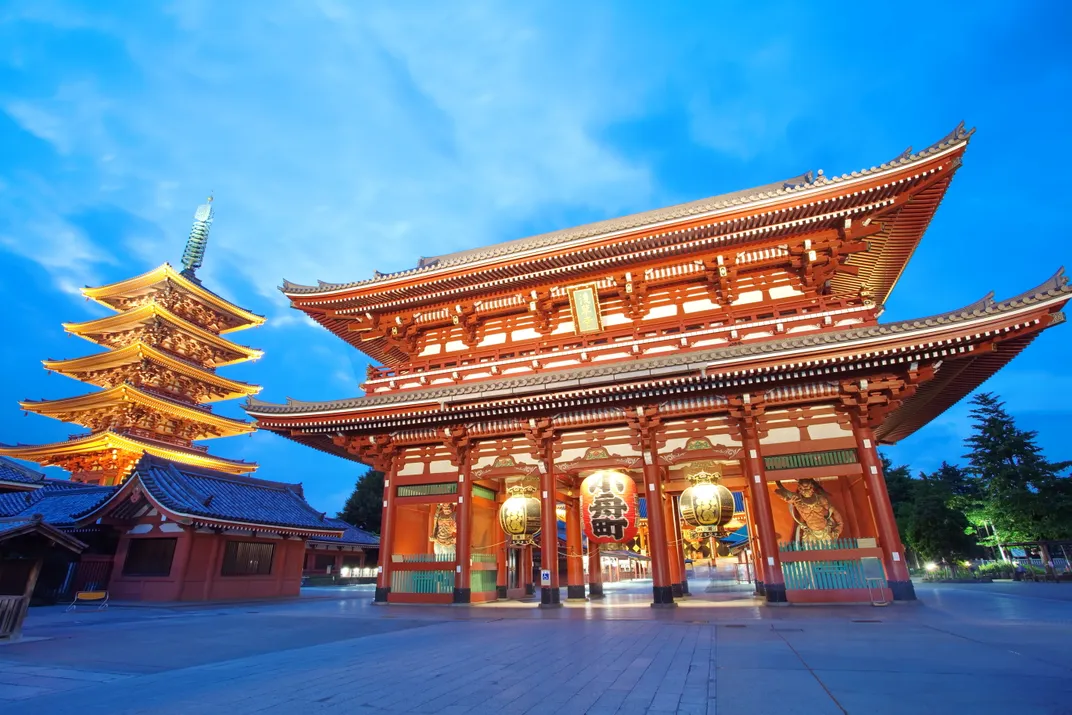
Begin the day with a visit to Asakusa Kannon Temple, also known as Senso-ji, which was built in 645 and is the oldest temple in Tokyo. Approach the shrine through the Kaminarimon (Thunder Gate), and stroll along the shopping street of Nakamise to the temple's second gate, the Hozomon. Later, zoom to the top of Tokyo SkyTree, one of the world’s tallest structures, for spectacular views of the city. Tour guardhouses, moats, and gardens on the grounds of the Imperial Palace before lunch with the group. In the afternoon, join an instructor to learn the steps and symbols of a traditional Japanese tea ceremony. Dinner and the evening are on your own. (B,L)
Day 13 — Tokyo
Pay a morning visit to Meiji Jingu, an important Shinto shrine dedicated to Emperor Meiji and his consort, Empress Shoken, who are credited with creating the foundations for modern Japan during the Meiji Restoration. Meander along tranquil paths that wind through the trees, passing under a massive torii gate before reaching the main shrine complex. Then head into the nearby Harajuku neighborhood, an effervescent hub of street art and fashion. Take a walk along Takeshita-dori, soaking up the eclectic ambiance of its quirky boutiques and themed cafes. After a free afternoon, celebrate your journey at a farewell reception and dinner. (B,R,D)
Day 14 — Return Home
After breakfast, depart for Narita International Airport for your flight home. Most flights to the U.S. arrive home the same day. (B)
Please note that the progression of this planned itinerary and/or its inclusions may be altered due to unforeseen operational considerations.
Included meals are denoted as follows: Breakfast (B), Lunch (L), Reception (R), Dinner (D)
/https://tf-cmsv2-journeys-media.s3.amazonaws.com/filer/c4/3a/c43aef58-c115-405e-8e07-a521737c2a01/jpn_kyoto_fushimiinarishrine_geishas_ss_550609591.gif)
/https://tf-cmsv2-journeys-media.s3.amazonaws.com/filer/c4/3a/c43aef58-c115-405e-8e07-a521737c2a01/jpn_kyoto_fushimiinarishrine_geishas_ss_550609591.gif)
/https://tf-cmsv2-journeys-media.s3.amazonaws.com/filer_public/92/24/922470c0-af7c-4704-aed5-5b795b3813ed/kor_seoul_bukchon_hanok_village_ist-1134149858.jpg)
/https://tf-cmsv2-journeys-media.s3.amazonaws.com/filer_public/ff/4b/ff4b9a77-8076-46a4-8bbb-593655e3cc25/kor_seoul_gyeongbokgung_palace_ist-509661920.jpg)
/https://tf-cmsv2-journeys-media.s3.amazonaws.com/filer_public/ed/43/ed43c2cd-2f3a-43e6-86f1-42b397d3c707/skr_dmz_prayerribbons_ist_864420684.jpg)
/https://tf-cmsv2-journeys-media.s3.amazonaws.com/filer_public/37/76/37762e64-3d27-45d0-a3b1-99098aea565a/kor_seoul_gyeongbokgung_palace_ist_485296883.jpg)
/https://tf-cmsv2-journeys-media.s3.amazonaws.com/filer_public/b4/49/b449fe9b-03bc-4e8e-957d-d8b0b5ea933c/skr_suwon_hwaseongfortress_ist_485751352.jpg)
/https://tf-cmsv2-journeys-media.s3.amazonaws.com/filer_public/48/05/4805e31b-035b-422e-bfd3-f9aa71284ec1/kor_dmz_observation_tower_ist-1066285142.jpg)
/https://tf-cmsv2-journeys-media.s3.amazonaws.com/filer_public/a8/65/a8658b9a-64dc-46de-b08a-ae6b3fde63c4/kor_dmz_bullet_holes_ist-1303533068.jpg)
/https://tf-cmsv2-journeys-media.s3.amazonaws.com/filer_public/c4/f0/c4f0a9ec-ca5b-4aa2-bc86-359a41cd8ea0/skr_seoul_streetfood_ist_905780748.jpg)
/https://tf-cmsv2-journeys-media.s3.amazonaws.com/filer_public/1d/39/1d3980b6-e07f-4fff-b103-87c929b2caab/kor_food_trad_dishes_ist-1011673124.jpg)
/https://tf-cmsv2-journeys-media.s3.amazonaws.com/filer_public/9f/4b/9f4b7835-ed34-4d0c-8791-929293679466/jpn_kyoto_giondistrict_dt_l_399165425.jpg)
/https://tf-cmsv2-journeys-media.s3.amazonaws.com/filer_public/7a/95/7a95ff7a-1ba8-4a07-bf69-0e481e9493ce/jpn_kyoto_gionneighborhood_ist_542829598.jpg)
/https://tf-cmsv2-journeys-media.s3.amazonaws.com/filer_public/53/e7/53e7419e-9636-40f5-a786-9b34d9c839ee/jpn_kyoto_kiyomizutemple_ss_2553899699.jpg)
/https://tf-cmsv2-journeys-media.s3.amazonaws.com/filer/a7/3c/a73c6fea-7792-4baf-b595-c5e7835098c7/jpn_kyoto_kiyomizutemple_dt_xl_47527876.jpg)
/https://tf-cmsv2-journeys-media.s3.amazonaws.com/filer/bb/35/bb35f2da-d807-4e98-86c4-ca5a6be5f14e/jpn_kyoto_fushimiinarigate_dt15543174.jpg)
/https://tf-cmsv2-journeys-media.s3.amazonaws.com/filer_public/85/76/8576d201-a999-4304-ac2c-f528cde372e1/jpn_kyoto_heianshrine_dt_l_84528109.jpg)
/https://tf-cmsv2-journeys-media.s3.amazonaws.com/filer_public/32/0d/320d844d-c0d0-4d0a-a544-f6a84c08eda6/jpn_kyoto_arashiyama_bambooforest_dt_l_106095659.jpg)
/https://tf-cmsv2-journeys-media.s3.amazonaws.com/filer/1f/4f/1f4ffde2-73fb-4c64-9495-fc28902bcf76/jpn_nara_todaijitemple_dt_xl_29207576.jpg)
/https://tf-cmsv2-journeys-media.s3.amazonaws.com/filer_public/67/0d/670d8bd5-20e9-4d87-a44d-b9753a14fac8/jpn_nara_todai-jitemple_deer_dt_91457931.jpg)
/https://tf-cmsv2-journeys-media.s3.amazonaws.com/filer/55/29/55299a47-5818-436a-8332-6b2fcb33e0db/jpn_nara_todaijitemple_buddha_dt_l_64969120.jpg)
/https://tf-cmsv2-journeys-media.s3.amazonaws.com/filer_public/e7/87/e787c8a6-755c-4892-8be9-368a1dba305e/jpn_nara_kasugataishashrine_dt_l_319258825.jpg)
/https://tf-cmsv2-journeys-media.s3.amazonaws.com/filer_public/8a/fc/8afc9930-44f4-4151-af15-39614d723cc5/jpn_nara_kasugataisha_stonelanterns_dt_l_48467703.jpg)
/https://tf-cmsv2-journeys-media.s3.amazonaws.com/filer/7e/aa/7eaa9c22-aaaa-471d-b57d-4cf0bb0b539b/jpn_bullettrain_dt_l_49438046.jpg)
/https://tf-cmsv2-journeys-media.s3.amazonaws.com/filer/e4/8d/e48dd9d9-7994-4adc-bc17-ede65d9d6be5/jpn_mtfuji_ashilake_ist_839688614.jpg)
/https://tf-cmsv2-journeys-media.s3.amazonaws.com/filer/02/e5/02e52fea-28e8-4a6d-bf7e-02e67ecdf0e4/jpn_tokyo_ginza_ist_1162936650.jpg)
/https://tf-cmsv2-journeys-media.s3.amazonaws.com/filer/c7/9e/c79ed533-3a06-4d83-ab7a-b38fc9fafdc7/jpn_tokyo_sensoji_asakusatemple_dt_l_47430262.jpg)
/https://tf-cmsv2-journeys-media.s3.amazonaws.com/filer_public/19/de/19de5299-c557-4127-ba2f-b8eccb38c765/jpn_tokyo_imperialpalace_dtl_99210443.jpg)
/https://tf-cmsv2-journeys-media.s3.amazonaws.com/filer_public/b7/85/b785abb2-043f-4317-ac0f-fd82fdc3dfae/jpn_tokyo_meiji-jingutemple_toriigate_dt_l_78028805.jpg)
/https://tf-cmsv2-journeys-media.s3.amazonaws.com/filer_public/b7/61/b761c3d0-cb4e-4335-9e62-d5ddd150fb97/jpn_tokyo_meiji-jingushrine_dt_l_57909004.jpg)
/https://tf-cmsv2-journeys-media.s3.amazonaws.com/filer_public/7b/d2/7bd26a94-d9a1-445f-a945-49db0bb0edfb/jpn_teaceremony_ist_544590230.jpg)
/https://tf-cmsv2-journeys-media.s3.amazonaws.com/filer/fb/0c/fb0c85e3-de12-4cbf-8caa-5cf6a7131ae3/jpn_tokyo_evepanorama_ist_1135121963.jpg)
Dates & Prices
Click on the departure date to see pricing. Click the for more information.
Dates
Availability
Price
Apr 5 - 18, 2027
Available
from $8,990
Apr 12 - 25, 2027
Available
from $8,990
May 10 - 23, 2027
Available
from $8,990
Oct 11 - 24, 2027
Available
from $8,990
| Occupancy | Double | Single |
|---|---|---|
| Price | $8,990 | $10,985 |
Oct 18 - 31, 2027
Available
from $8,990
When considering air travel arrangements for this program, travelers should plan to arrive in Seoul, South Korea, on Day 3 of the published program. One day is lost in flight on the westbound transpacific flight and will be re-gained on the return to the U.S. A group flight in economy class seating from Seoul, South Korea, to Osaka/Kyoto, Japan, is included in the program price and your air tickets will be distributed on tour.
Special Air Rates & Services: As part of our special air program, FlexAir, available with this tour, you can choose from a wide variety of flight options. Visit the Tour Details tab and click on "Special Air Rates/Services" drop down.
Prices are based on rates of exchange, airfare & fuel (where applicable), tariffs, taxes, and other costs as of the tour publication date. We reserve the right to correct errors and to increase program prices to cover increased costs, tariffs, and taxes received after prices are published and to reflect currency fluctuations.
/https://tf-cmsv2-journeys-media.s3.amazonaws.com/filer_public/92/24/922470c0-af7c-4704-aed5-5b795b3813ed/kor_seoul_bukchon_hanok_village_ist-1134149858.jpg)
Experts
/https://tf-cmsv2-journeys-media.s3.amazonaws.com/filer_public/9e/7f/9e7fc08a-ab1c-4560-8e25-ae67c89fd3b2/williams_marjorie.jpg)
Marjorie Williams
Art Historian
Marjorie Williams has had a lifelong passion for Asian art. A museum professional for over 45 years, Marjorie was on staff of the Cleveland Museum …
Marjorie Williams has had a lifelong passion for Asian art. A museum professional for over 45 years, Marjorie was on staff of the Cleveland Museum of Art until 2021, serving in different capacities, including as director of the Department of Education and Public Programs and senior director for endowment development. Her consistent focus, however, has been the museum’s extraordinary Asia collection. She has lectured, organized educational exhibitions, and written catalogues and articles about Asia’s artistic traditions and their importance in world art. From 1987 to 2021, she also served as an adjunct associate professor in the Department of Art History at Case Western Reserve University. Since 1990, Marjorie has been a lecturer on tours to Japan, China, Hong Kong, and South Korea. When not traveling, she enjoys researching 19th century travel diaries.
+ Show more
/https://tf-cmsv2-journeys-media.s3.amazonaws.com/journeys/expert/McDonald-Louisa.jpg)
Louisa McDonald
Art Historian
Louisa McDonald is an associate professor of art history and chair of the Department of Art at the University of Nevada, Las Vegas (UNLV) who …
Louisa McDonald is an associate professor of art history and chair of the Department of Art at the University of Nevada, Las Vegas (UNLV) who specializes in Japanese art. She earned a PhD in East Asian art from Stanford University, focusing on medieval Japanese narrative scroll painting, and did post-graduate studies in Japanese art history at Tokyo University. After a postdoc at Harvard University, where she was an associate in research at the Edwin O. Reischauer Institute for Japanese Studies, Louisa taught in New England and then joined the faculty at UNLV. Her scholarly interests range widely from French Japonisme to modern and contemporary Japanese art. Currently, her research is focused on the relationship between art and war, particularly the World War II art of the Japanese artist Fujita Tsuguharu (1886-1968). She contributed to and co-edited Art and War in Japan and its Empire: 1931-1960, an anthology of art historical essays.
+ Show more
/https://tf-cmsv2-journeys-media.s3.amazonaws.com/journeys/expert/Hall-Jonathan.jpg)
Jonathan Hall
Cultural Historian
Jonathan M. Hall teaches courses in Japanese literature, media, film and aesthetics at California State University San Bernardino. His broad pedagogy includes Classical Japanese Literature, …
Jonathan M. Hall teaches courses in Japanese literature, media, film and aesthetics at California State University San Bernardino. His broad pedagogy includes Classical Japanese Literature, Cultures of the Floating World, women’s & minority literatures, and Japanese film, animation, & manga. Jonathan's published articles and book manuscript include writing on kabuki dance, Japanese postwar photography & performance, and twentieth-century Japanese film. Jonathan is also active as a film subtitler and as a contemporary performance dramaturge. Following graduate work that he pursued dually at the University of Tokyo and the University of California Santa Cruz, Jonathan has taught at the University of Chicago, the National University of Fine Arts and Music in Tokyo, the University of Leeds (UK), and several University of California campuses.
+ Show more
/https://tf-cmsv2-journeys-media.s3.amazonaws.com/filer_public/ff/4b/ff4b9a77-8076-46a4-8bbb-593655e3cc25/kor_seoul_gyeongbokgung_palace_ist-509661920.jpg)
Tour Details
Accommodations
Novotel Ambassador Youngsan
Seoul, South Korea
Located in the heart of Seoul’s dragon city, a massive hotel and entertainment complex which opened in 2017 and in close proximity to Yongsan Station, Novotel Ambassador Seoul Yongsan features 621 spacious and modern rooms, all with views of the city scape or the Han River. There is a choice of a king or two twin beds, plus an area for a work desk, safe, and coffee/tea station. There are bright ensuite baths with shower and tub as well as fine bath amenities. There are several dining options within the hotel and an indoor pool and fitness center onsite.
Dhawa Yura Kyoto
Kyoto, Japan
The Dhawa Yura Kyoto is located in the heart of Kyoto close to the Gion area and near some of the cities stunning temples and shrines. Unwind in stylish accommodations where Japanese tradition and Western influence come together in contemporary design. Guest rooms feature two twin or king bed, a writing desk, sitting area and full ensuite baths. There is an all-day restaurant serving both Japanese and Western specialties as well as a cozy lounge. There is a small fitness area and spa on the property.
Westin Tokyo
Tokyo, Japan
Just steps from Ebisu Station in central Tokyo, the 438 guest room Westin Tokyo is nestled within the lush greenery and cultural charm of Ebisu Garden Place., with convenient access to Shibuya, one of Tokyo’s most vibrant districts. Guest rooms feature king or two double beds, seating area and work desk Marble baths include a separate tub and shower as well as a lighted vanity. All guest rooms feature breathtaking views of the surrounding city, There are several dining options on site featuring both Japanese and International fare. There is also a small spa and fitness center on site.
Activity Description
Expectations: This Land Journey will feature long touring days, many full-day excursions, and standing and walking for extended periods of time at historic sites and shrines and over terrain that may be uneven (cobblestones, city hills, stairs without handrails, ruins, steep trails with muddy and slippery conditions). Some excursion may require navigating some steep ascents/descents, and walking in city centers where coaches are prohibited. Travel by plane from Seoul/Incheon, South Korea to Osaka/Kansai, Japan in economy class is included in price of the program. High-speed and local trains as well as some early morning departures and some later evening arrivals can be expected. There is leisure time built into the itinerary on some days to allow for independent exploring.
Appropriate for: Travelers who are physically fit, lead active lives, are comfortable participating in long days of activities, and expect some physical exertion.
Reading List
*As an Amazon Associate, Smithsonian Journeys earns from qualifying purchases.
Highly Recommended
Also Recommended




Special Air Rates/Services
FlexAir is designed to provide our guests with the flexibility and choice they need to personalize their air travel experience. They can explore a wide range of flight options* in consultation with our experienced air travel professionals to select the flights, routing, class of service, and dates of travel that most fit their needs. Our partner tour operator has negotiated contracts with a wide variety of carriers that allows them to search for the air itinerary that meets the requirements of our guests, and once satisfied with the flights, seating, and pricing, in most cases, can be confirmed and ticketed** immediately.
The FlexAir program includes:
- Confirmed airline seat assignments at the time of ticketing (in most cases additional purchase may be necessary)
- Assistance with schedule changes and delays, including after-hours support
- Guaranteed transfers between the airport and overseas accommodations upon arrival and departure (based on the group’s arrival and departure dates), and the details needed to guarantee the transfer
Important Notes:
*Most airline schedules become available for ticketing approximately 320 days from the date of return travel.
**Once ticketed, certain restrictions will apply. Our air travel professionals will provide the details.
Travel Insurance
For the convenience of our travelers, Smithsonian Journeys includes a basic medical expense and evacuation plan through Trip Mate, a Generali Global Assistance & Insurance Services brand, at no additional charge. This plan provides post-departure Medical and Dental coverage of $250,000 per person and Emergency Assistance and Transportation coverage of $1,000,000 per person (U.S. Residents Only). Note: For full details regarding these coverages please review the following Plan Documents here.
In addition, we recommend that travelers purchase a travel protection plan to help protect their travel investment from unforeseen events such as cancellation due to illness, flight delays due to adverse weather, baggage loss, and more. For your convenience, Smithsonian Journeys offers an optional Travel Protection Plan administered by Trip Mate, a Generali Global Assistance & Insurance Services brand. For those interested, optional "Cancel for Any Reason" coverage is available for an additional charge. Note: Certain eligibility requirements apply and Cancel for Any Reason coverage is not available to New York residents. For full details regarding this coverage please review the following Plan Documents here.
To learn more about the Travel Protection Plan, you may visit https://www.generalipartner.com/smithsonianjourneys or call the administrator, Trip Mate, a Generali Global Assistance & Insurance Services brand at (866) 501-3252.
Related Tours
/https://tf-cmsv2-journeys-media.s3.amazonaws.com/filer/bb/35/bb35f2da-d807-4e98-86c4-ca5a6be5f14e/jpn_kyoto_fushimiinarigate_dt15543174.jpg)
/https://tf-cmsv2-journeys-media.s3.amazonaws.com/filer/78/e2/78e234e7-ea1e-41d5-ab1f-073bbb133d96/jpn_tokyo_sensojitemple_asakusakannon_buddhisttemple_dt_l_33387330.jpg)
/https://tf-cmsv2-journeys-media.s3.amazonaws.com/filer_public/ff/4b/ff4b9a77-8076-46a4-8bbb-593655e3cc25/kor_seoul_gyeongbokgung_palace_ist-509661920.jpg)
/https://tf-cmsv2-journeys-media.s3.amazonaws.com/filer_public/65/03/6503bc48-52ad-4643-b1ad-20647f1f0f53/jpn_fukuoka_dazaifutenmangushrine_l_109174173.jpg)
/https://tf-cmsv2-journeys-media.s3.amazonaws.com/filer/5a/a4/5aa45cb1-be53-42d2-973a-b6a68ff89be9/uzb_samarkand_shahizinda_dt_l_45723845.jpg)
/https://tf-cmsv2-journeys-media.s3.amazonaws.com/filer_public/74/96/74960a71-f580-4cd0-9334-11b329668870/jpn_mtfui_lakekawaguchiko_ist_902420480.jpg)
Japan by Trail: An Active Journey featuring the Shikoku Pilgrimage Trail
11 days
|
from:
$7,699
Multiple departures between 2026 & 2027