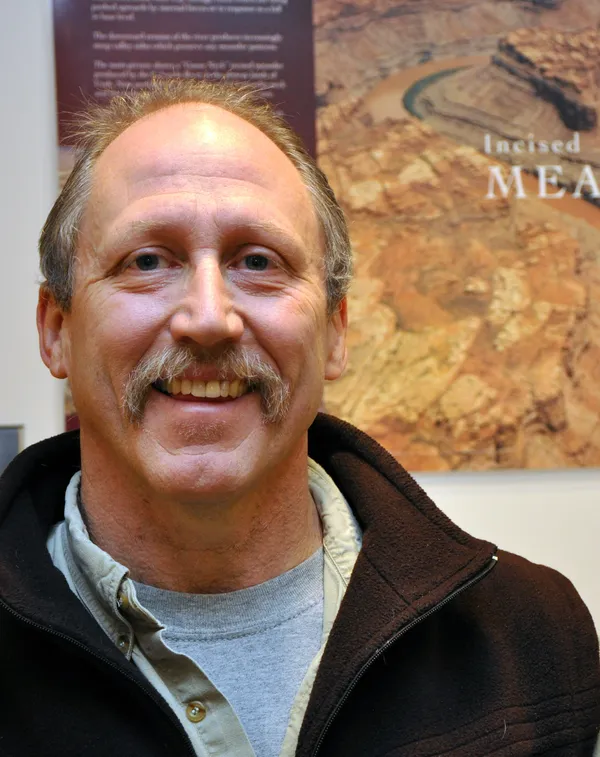
Smithsonian Journeys interview with David Clapp referencing various tours that he has led.
| Q: You have such wide-ranging expertise in science, ornithology, and natural history. How do you integrate your diverse knowledge to create a supreme learning experience on Smithsonian Journeys tours? |
| A: Curiosity is a wonderful thing. There is so much to see out there. Over the years I have learned that things are much more simple and much more complex than was ever imagined, and that allows for a tremendous breadth in looking at natural history. The relationships between organisms and their environment are often surprising, and yet usually quite understandable. The details are always a bit more complex than one expects but the overall sense of complexity and symmetry is really quite nice. I like to use everything from plate tectonics to molecular absorption to show a particular region, animal, or circumstance. Everything has general components and then everything also has very intricate actions. |
| Q: On your upcoming Smithsonian Journeys trip to Tanzania, you will be accompanying Smithsonian travelers into the Olduvai Gorge in northern Tanzania, often referred to as "The Cradle of Mankind," where Louis and Mary Leakey conducted their pioneering research in the 1950s and 1960s. Can you describe what it is like to explore a place that is so significant to human evolution? |
| A: The highlands of northern Tanzania are remarkable. When you see the actual gorge and remember the work that the Leakeys undertook, and then see the tools and bones collected at the site (in the small museum on the edge of the Oldupai Gorge) you can step back in time. East Africa seems to stimulate genetic memory in people. It is as if our DNA remembers its years on the African plain before it spread around the world. There are several things that bring this history to the mind of a visitorthe first smells of Africa as you step off the plane, the time spent with the Maasai people, and the feeling you get standing on the edge of Oldupai Gorge. |
| Q: What do you most look forward to seeing and experiencing on the Tanzania safari? |
| A: As a naturalist I can look at the birds and mammals all day every day. However, what strikes me most about northern Tanzania is the combination of beauty in the countryside, good spirits in the people, and the presence of wildlife unfettered. I am not so naïve as to think that this romantic description is totally true, but that is the feeling and sense I get when I am there. I like to see four-toed hedgehogs as much as I like cheetahs; I like the tiny purple grenadiers as much as I like the southern gray-crowned crane and the people who so openly share their country and history with us. |
| Q: You often lead Smithsonian Journeys to the Amazon. What is remarkable about this region? |
| A: The Amazon Basin contains more plants and animals than just about anywhere else in the world. The basin has remarkable complexity: poor soils; heavy rainfall; a river that rises and falls thirty (or more) feet a year; and vegetation that is tall, short, opportunistic, and full of little understood chemicals. The overview of the area, including forests, large birds, river dolphins, and river-edge people is quite breathtaking on its own. But when the ecological components are added and the geologic history is intertwined, it becomes a lesson plan for how the earth works. The Amazon is today what it is because the past two hundred million years were what they were. |
| Q: Iceland is another destination that you often visit. What types of wildlife can travelers see there? |
| A: Iceland is one of those places where contrast is a way of life. Volcanoes and glaciers, hot springs and snow fields; what more could you want? June is the breeding season for seabirds in this area. In Iceland we will see Atlantic puffin and razorbill by the thousands. Artic terns will grace us with their buoyant and elegant flight and their often rude nest defenses. Black-legged kittiwake and northern fulmar will eye us from their cliffside nests as we visit the stark volcanic cliffs. While at sea we will look for marine mammals. There have been twenty species of whales seen in Icelandic waters and two species of seal. The endangered northern right whale is also one of the species that we will look for. |
| Q: What do you find sets Smithsonian Journeys travelers apart from other groups that you have led, and what do you most enjoy about teaching Smithsonian members on tour? |
| A: I enjoy my travels with the Smithsonian as much for the people as for the destinations. Smithsonian travelers are interested in a wide array of subjects. They like to learn about cultures, people, the environment, and about specific species and their role within that environment. Questions are asked, answers researched, and consequences discussed. This breadth of interest makes every day a day of exploration and learning. |
| Q: Do you have a single most memorable experience from all of your travels as Study Leader with Smithsonian Journeys? |
| A: I have many memories of glorious sunsets, engaging wildlife, wonderful traveling companions, and spectacular vistas. I also remember lost luggage, missed flights, illnesses, and flat tires. But each altered plan offers another (unplanned) opportunity. Birding along an African track as the tire is changed is something that wasn’t on the itinerary but offers a chance to meet new wildlife and often new people as well. Everything is memorable; life is a box of chocolates you know–or at least a box of memories as good as you make them. |